








Pneumatics / Directional Control Valves - Electric / Pneumatic
Compact Solenoid Valves Serie K & E+V - 3/2, 5/2 and 5/3 with 16 and 22 mm Width
When every millimeter counts in the control cabinet or on the machine frame, the valve width determines the layout of the entire control system. The compact solenoid valves of the Serie K with 16 mm width and the Serie E+V with 22 mm width cover the common switching functions 3/2, 5/2 and 5/3 - pilot-operated, spool-type, in electric/spring, electric/electric, and pneumatically pilot-operated versions. You select based on the criteria that truly matter in design: switching diagram, valve width, port size from 1/8" to 1/2", nominal size and flow rate - as a single valve or mounted on a manifold sub-base.
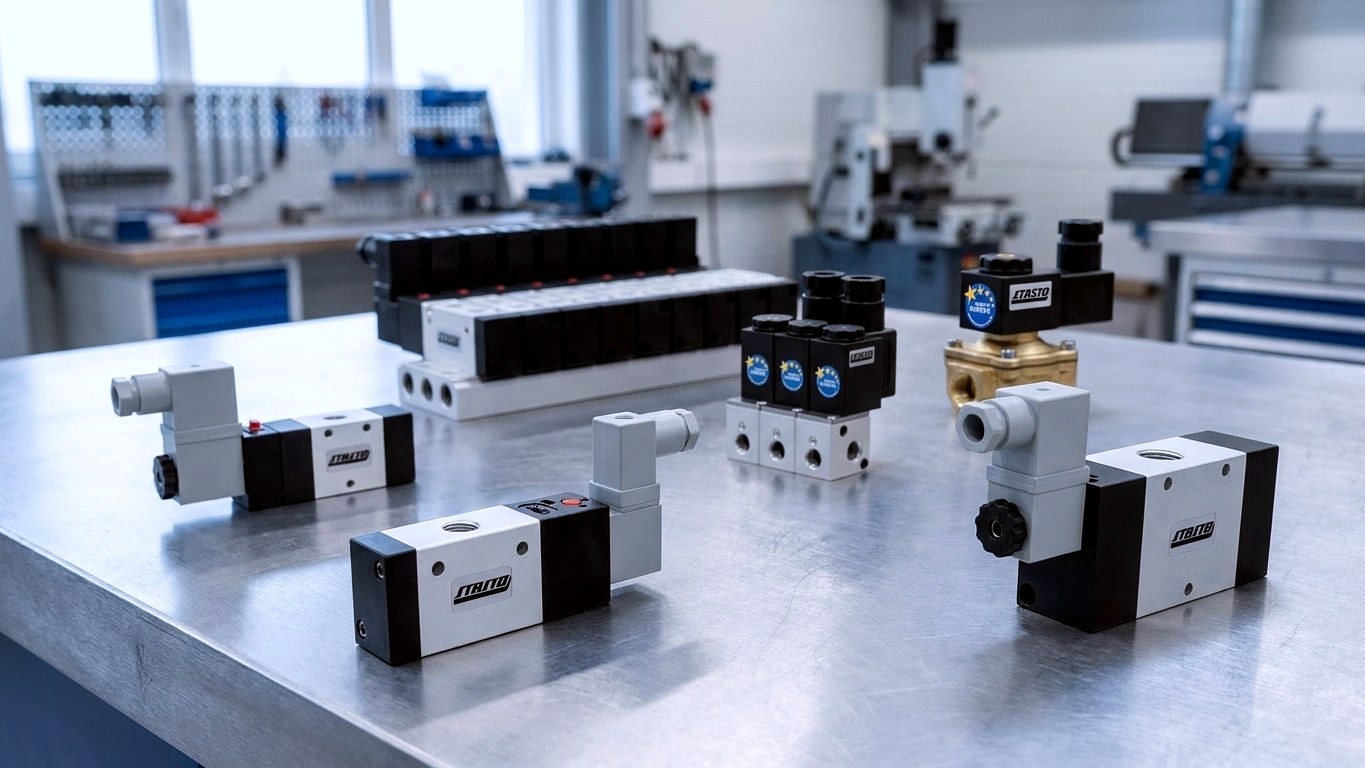
Two widths, three circuit diagrams
Why these series
Compact directional valves with a consistent system
Serie K and Serie E+V follow the same selection grid - from the circuit diagram through the actuation type to the setup as a single valve or valve battery.
Two widths, one selection grid
Serie K is built especially narrow with a 16 mm plug width, while Serie E+V with 22 mm delivers larger nominal sizes using the same logic. You can switch between both series without changing your selection criteria.
All three circuit diagrams from one system
3/2 for single-acting cylinders and pilot functions, 5/2 for double-acting actuators, 5/3 for mid-position stop and a defined center position. All within the same series and with the same connection pattern.
Single valve or valve battery
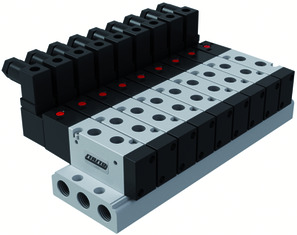
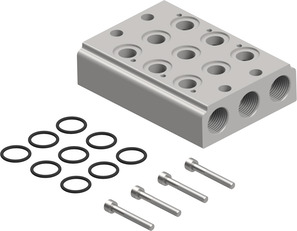
With the manifold base plate Serie K or Serie ME and the matching blanking plates (Serie K, Serie PCH), you can build interlinked assemblies. Reserve positions remain free for later expansion.
Coil and connector matching the series
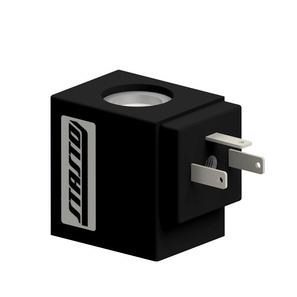
Solenoid coils of types C001, CS, SCN and EPC, as well as device connectors in the corresponding plug width, are part of the same system. Voltage, coil type and connector shape are selected per variant; versions without a coil are also available in the range.
Guide
Choosing the right compact solenoid valve
Circuit diagram, width, actuation type and mounting style - four decisions lead to the right variant.
3/2, 5/2 or 5/3 - which circuit diagram?
- 3/2 directional control valve
- Three ports, two switching positions: pressurizes or exhausts a single outlet. Suitable for single-acting cylinders, vacuum functions or as a pilot valve.
- 5/2 directional control valve
- Supplies two outlets alternately - one port is pressurized while the other is exhausted. Standard solution for double-acting actuators.
- 5/3 directional control valve
- Adds a third, middle position: blocked (actuator holds position) or exhausted (actuator becomes force-free).
- Key question
- The practical difference between 3/2 and 5/2 lies not in the design, but in the question: one working chamber or two.
16 mm or 22 mm width?
- Pitch spacing
- The plug-in width determines how many valves fit side by side on a manifold, and correlates with nominal size and flow rate.
- Serie K (16 mm)
- If the flow rate matches your cylinder diameter and cycle time, the Serie K gives you the most compact control setup.
- Serie E+V (22 mm)
- If higher flow rates or larger port sizes are needed, switch to the 22 mm Serie E+V.
- Key specifications
- Port size 1/8"-1/2", nominal diameter and the flow rate in Nl/min as stated in the datasheet; pressure ranges vary by series and variant.
Monostable or bistable?
- Monostable (electric/spring)
- If power fails, the valve returns to a defined rest position - essential wherever a fail-safe state is required.
- Bistable (impulse valve)
- Two coils, holds the last position even without a signal. Saves energy and reduces heat build-up, but requires a deliberate decision on behaviour in case of power loss.
- Pneumatically piloted
- The K3.P, K5.P and V-series variants are actuated without an electrical signal at the valve - for example via upstream pilot valves.
Single valve or valve bank?
- Single valve
- Practical for a few, spatially separated functions with their own piping.
- Manifold sub-base
- From around three to four functions in one location, a manifold sub-base saves piping, space and installation time.
- Blanking Plate
- Unused stations are closed off with blanking plates (Serie K, Serie PCH) and remain available as reserve positions.
- Valve Island
- If you want to centralize further, look into solenoid valve batteries and islands, such as the Serie 4HF valve island.
Circuit diagrams compared
Difference Between 3/2, 5/2 and 5/3 Way Valve
All three switching functions are available in both connector widths - the choice depends on the actuator and the desired behavior in the rest position.
| 3/2 | 5/2 | 5/3 | |
|---|---|---|---|
| Ports / Positions | 3 ports, 2 positions | 5 ports, 2 positions | 5 ports, 3 positions |
| Typical Actuator | Single-acting cylinder, vacuum, pilot function | Double-acting cylinder | Double-acting cylinder with mid-position |
| Mid-Position | - | - | Locked or vented depending on version |
| Series K (16 mm) | K3.W, K3.P, dual 3/2 K6.W/K9.W | K5.W1 (mono-stable), K5.W2 (bi-stable), K5.P1/K5.P2 | K5.W, K5.P |
| Series E+V (22 mm) | E3., V3 | E5., V5 | E5., V5 |
| Actuation | Electric/spring-return or pneumatically pilot-operated | Electric/spring or electric/electric | Electric/electric or pneumatically pilot-operated |
Product Range
Compact solenoid valves by series and circuit diagram
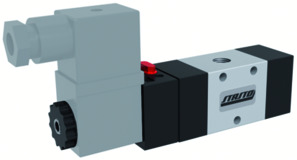
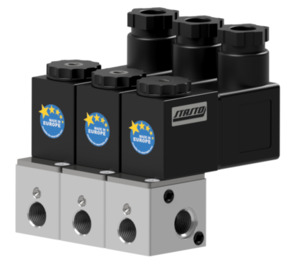
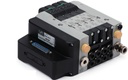
Series K with 16 mm plug width, series E+V with 22 mm - plus manifold base plates and blanking plates for ganged assemblies.
Applications
Where these valves are used
From compact control panels in special-purpose machinery to valve actuation in process plant engineering.
Machine building and special-purpose machinery
Actuation of double-acting cylinders via 5/2-way valves. Where installation space on the control panel is limited, the 16 mm width of Serie K pays off, since more stations fit on the same manifold length.
Handling and assembly technology
Grippers, slides and separators with short cycle times. Here, alongside the circuit diagram, flow rate is what matters most, as it limits the achievable cylinder speed.
Packaging and conveyor technology
Bistable 5/2 valves hold their position without continuous power. This reduces heat build-up in densely populated terminal boxes.
Positioning and holding functions
5/3-way valves with blocked center position for intermediate stops, or with exhausted center position for a pressureless, force-free actuator state.
Process and plant engineering
Actuation of pneumatic actuators on valves. For areas with special explosion-protection requirements, versions with an ATEX solenoid coil type EPC are available depending on the variant - check details per variant.
Separate circuits in confined spaces
The double 3/2-way valve series K6.W/K9.W combines two independent 3/2 functions in a single housing. Ideal when two circuits need to be switched separately within a confined space.
Making procurement plannable
Availability depends on variant - status shown directly on the item
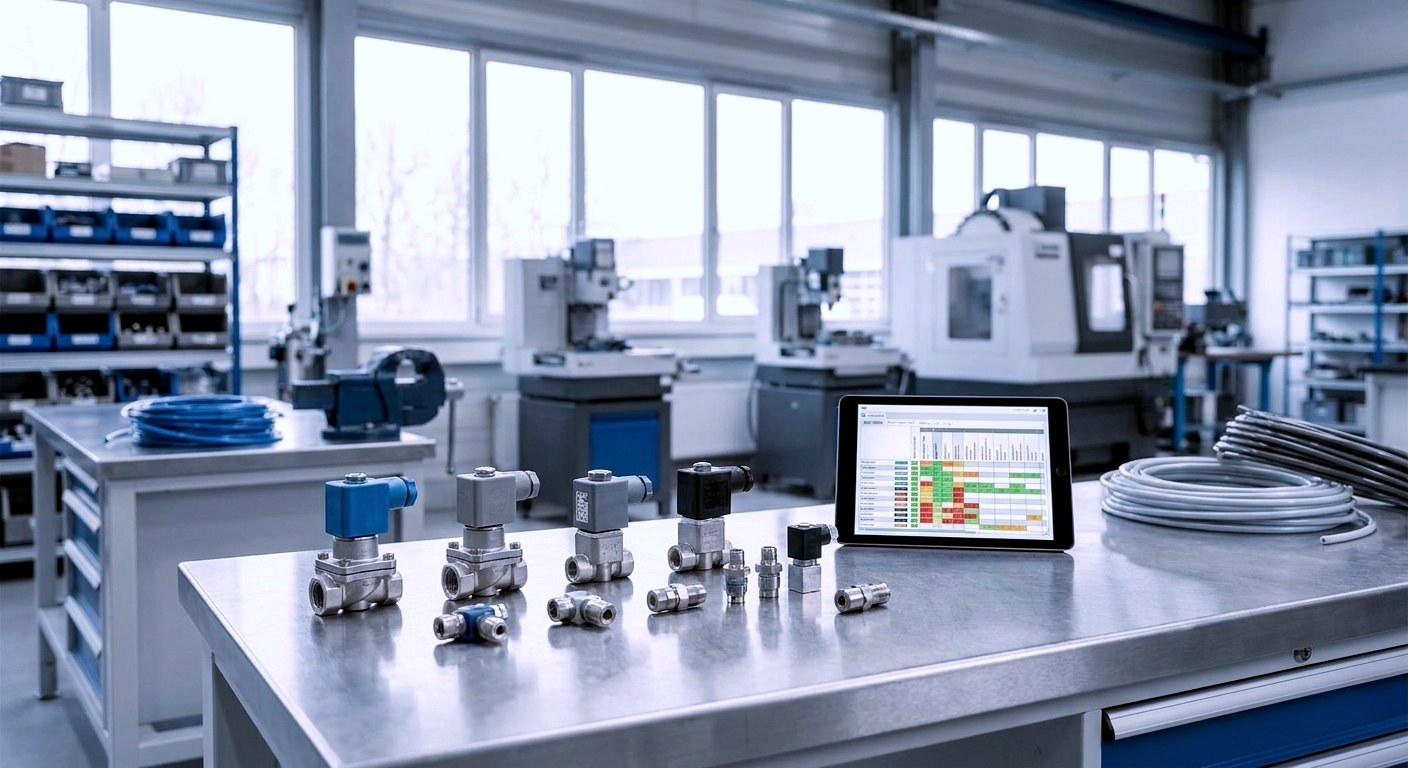
Common versions of the K and E+V series are often available short-term depending on port size, function (NC/NO) and coil type; other variants are manufactured to order. You can see the current status directly on the respective item; for framework orders, tiered quantities or recurring requirements we provide lead time and price on request.
Self-explanatory part numbers
The numbering logic of the series is self-explanatory - example K32W1S614: 3/2-way, series K3.W, plug width 16 mm, port 1/4". This simplifies reordering and spare parts stocking.
Special versions on request
ATEX variants with solenoid coil type EPC or versions for different ambient conditions can be realised depending on the variant and are coordinated on a project basis. Please refer to the datasheet of the specific variant for marking and scope of approval.
Accessories assigned per series
Silencers, connector sockets and blanking plates are assigned to the respective series and are offered together on the item page.
Check variant-specific specifications
Pressure range, nominal size and flow rate in Nl/min vary depending on series and version and are stated on the respective item variant.
How to find your variant
Three steps to the right valve
Define circuit diagram, mounting width and configuration - the rest is clarified by the variant data on the item.
Define circuit diagram
One working chamber or two? 3/2 for single-acting actuators, 5/2 for double-acting, 5/3 when a blocked or exhausted mid-position is needed.
Choose mounting width and connection
Series K with 16 mm or Series E+V with 22 mm connector width - determined by port size (1/8"-1/2"), nominal diameter and required flow rate in Nl/min.
Configure setup and coil
Single valve or manifold sub-base with blanking plates, monostable or bistable, coil type and voltage - we'll clarify any open questions together.
Frequently Asked Questions
FAQ on Compact Solenoid Valves Series K and E+V
Answers on circuit diagrams, mounting width, coils and special designs.
What is the difference between a 3/2 way valve and a 5/2 way valve?
The 3/2 way valve switches one outlet between pressurized and vented and is typically used for single-acting cylinders. The 5/2 way valve switches two outlets alternately and is therefore intended for double-acting cylinders.
What is a 5/3 way valve with vented mid-position used for?
For applications where the actuator needs to be pressureless and force-free in a defined intermediate position - for example during setup or controlled shutdown. Alternatively, the blocked mid-position is available when the position needs to be held.
What does the connector width specification of 16 mm or 22 mm mean?
The connector width describes the mounting width of the valve or the coil/connector combination and thus determines the pitch and space requirement on the connector plate. Series K has a width of 16 mm, Series E+V has 22 mm.
Are the valves available without a solenoid coil?
Yes, depending on the design, variants are listed with or without coil and connector. Matching solenoid coils (including type C001, CS, SCN, EPC) and connectors can be found in the corresponding category.
Are there versions available for hazardous (ATEX) areas?
For both series, depending on the variant, versions with ATEX solenoid coil type EPC are available. Please refer to the datasheet of the specific variant for ignition protection type and marking; we're happy to work with you to determine the right version.
What is a monostable versus a bistable directional control valve?
Monostable (electrically/spring-operated) means that the valve returns to a defined rest position in the event of a power failure. Bistable (impulse valve with two solenoid coils) holds the last switched position even without a signal.
When does a manifold sub-base make sense?
From about three or four functions in one location, a manifold sub-base saves on piping, space, and installation time. Unused stations are closed off with blanking plates (Serie K, Serie PCH) and remain available as spares for future expansion.
What is a double 3/2 directional control valve used for?
A double 3/2 directional control valve combines two independent 3/2 functions in a single housing. STASTO offers the Serie K6.W and K9.W in 16 mm width for this purpose.
Goes well with this
Related Categories
Supplementary components for control, manifolding and coil technology.
Next step
Valve selected - or still have questions on sizing?
You know the circuit diagram, connection size and mounting width? Then go straight to the series and select your variant with function, coil type and voltage. If flow rate, control or the distribution across manifold plates is still open, we'll review your application together and propose a suitable combination of valve, coil and connector plate.